
February 04, 2026/ Toronto, ON / Newsfile Corp. Delta Resources Limited (“Delta” or “the Company”) (TSX-V:DLTA) (OTC Pink:DTARF) (FRANKFURT:6GO1) Delta is pleased to announce the discovery of a potential new gold zone in the Wedge area approximately 4 kilometres west of the Eureka Gold Deposit in Thunder Bay, Ontario. Assay results are from an additional two (2) drill holes completed as part of its recent 26-hole, 5,237-metre Fall 2025 diamond drill program. Delta is also pleased to announce the commencement of a 1,400-metre follow-up drill program at the Company’s flagship Delta-1 Property, located approximately 50 kilometres west of Thunder Bay, Ontario.
Highlights:
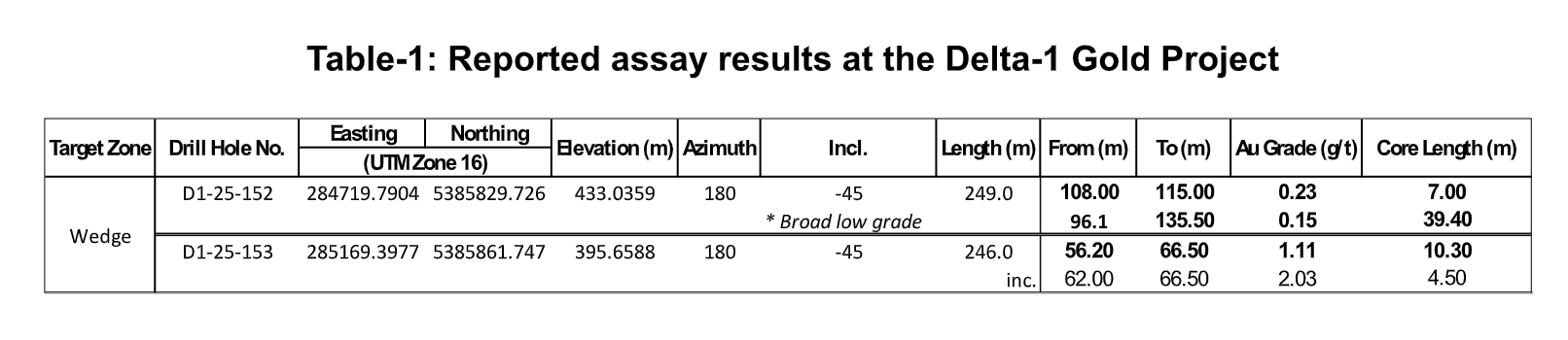
- New gold intercept in hole D1-25-153 at the Nova target (Wedge area), located approximately 450 metres east of the Wedge Zone and 4 km west of the Eureka Gold Deposit, returning 1.11 g/t Au over 10.3 metres.
- Confirmation of gold mineralization at the Wedge Zone in hole D1-25-152.
- Follow-up drilling underway at Wedge Zone, Nova Target, and Kaspar Target, supported by enhanced geophysical targeting based on results from a recently completed 194.6 line-kilometre high-resolution, drone-based magnetic survey.
Ron Kopas, Chief Executive Officer (Interim) of Delta, commented:
“The discovery of a potential new gold zone at Nova Target in the Wedge area highlights the exceptional upside for additional significant discoveries across our extensive Delta-1 property. This is particularly encouraging given our success at the Shabaqua Target (see Delta’s January 12, 2026 press release), where autumn drilling returned 4.25 grams over 11.8 metres. As we continue to advance the Eureka Gold Deposit through infill and metallurgical work, we believe the ongoing discoveries of additional gold sources on the Delta-1 property, that could be developed synergistically with the Eureka Deposit, continue to strengthen the project economics in this low-cost jurisdiction. This opportunity is further strengthened by our strategic location just 50 km from Thunder Bay, which is an established hub for mining operations in Northern Ontario where we are seeing increasing positive results from neighbouring projects (see recent Goldx2 press release).
In addition, we are pleased to announce a follow-up drill program on the heels of this new discovery. With the recent announcement of the $8,250,000 option agreement to monetize our Delta-2 property in Québec, we are well positioned to continue funding our exploration and project development activities. to advance the Delta-1 property.”
Drill Program Stats:
Total number of holes drilled: 26
Metres drilled: 5,237
Number of holes reported here: 2
-
- Shabaqua Target: 14 holes (2,474 m)
- Eureka South: 3 holes (888 m)
- Eureka West: 4 holes (894 m)
- Eureka Infill/Met work: 2 holes (285 m) – assays pending
- South Till Anomaly: 1 hole (201 m)
- Wedge: 2 holes (495 m)
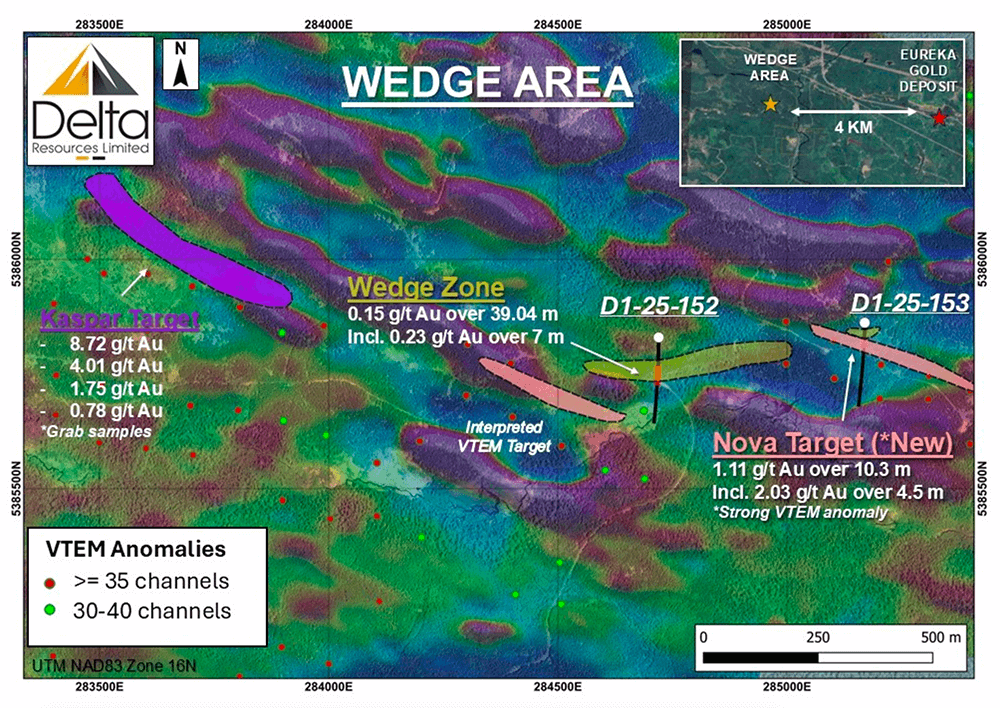
Figure-1: Drill hole location map
The Company is reporting results from two of the four remaining drill holes from the 26-hole Fall 2025 program that have not previously been reported. Review and interpretation of the remaining two infill and metallurgical testing drill holes is currently underway, with results expected to be released shortly.
Wedge Area
Glacial till sampling conducted by Delta across multiple programs on the Delta-1 property has identified a strong gold anomaly originating from the Wedge area, located approximately 4 km west of the Eureka Gold Deposit. The Wedge area includes the Wedge Zone, the new Nova Target, and the Kaspar Target spanning a distance of almost 1.5 km. The Kaspar Target has the highest single gold grain count in till recorded across the entire area. To date, mineralization within the Wedge area appears to occur in at least two distinct styles, highlighting the strength and complexity of the gold system.
Wedge Zone
The previously identified Wedge Zone mineralization had minimal drill testing in 2003 and has since been verified by Delta Resources through multiple surface sampling programs conducted in recent years. The zone is characterized by pervasively ankerite-sericite-silica altered felsic to intermediate intrusive rocks with quartz-carbonate veinlets and disseminated pyrite and arsenopyrite. This zone was intersected across 27.3 m in D1-25-152 yielding 0.23 g/t Au over 7 m. D1-25-153, drilled 450 m to the east, also intersected the Wedge zone with isolated grades of up to 0.73 g/t Au. This demonstrates the significant potential for this zone to continue to extend along-strike.
Nova Target
A second, and new, style of mineralization, associated with a series of massive pyrite lenses, was observed in drill hole D1-25-153 which yielded a grade of 1.11 g/t Au over 10.3 m. The location of the gold-bearing massive pyrite lenses corresponds with a 500 m long VTEM anomaly running parallel to the regional foliation.
The two holes completed in the Wedge Area during the latest program successfully expanded the known extent of the Wedge Zone by almost 400 m to the east, and identified a new style of mineralization, providing an exciting new target to follow up on and further expanding the mineralized footprint in the Wedge area.
Kaspar Target
The Kaspar target is located over 900 m from the original Wedge Zone discovery area and hole D1-25-152. Multiple gold-bearing samples were collected by Delta in one specific area with results including 8.72 g/t Au, 4.01 g/t Au and 1.75 g/t Au. Mineralization is associated with quartz-carbonate veins and disseminated and bands of pyrite in iron formation, chert, and bedded sedimentary rocks
Follow-Up Drill Program
Further drilling in the Wedge area will focus on, 1) continuing to expand the footprint of the Wedge Zone, 2) testing the extent of the gold-bearing massive pyrite lenses and their association with the strong VTEM anomalies in the area (Nova Target), and 3) drill testing the Kaspar Target.
Analytical Protocol and QA/QC
Chemical analyses reported in this news release were performed by AGAT Laboratories, an independent analytical laboratory accredited to ISO/IEC 17025 by the Standards Council of Canada (SCC). Sample preparation was completed at AGAT’s facility in Thunder Bay, Ontario. All sampling and analytical procedures were conducted under a comprehensive Quality Assurance/Quality Control (QA/QC) program, including the insertion and monitoring of certified reference materials (standards), blanks, and duplicate samples.
To minimize assay variability associated with the nugget effect from coarse and/or visible gold, the Company implemented the following assaying protocol at Delta-1:
Where visible gold is observed in the sample or where the sample is derived from an interpreted mineralized zone, the assay is performed by Metallic Screening. In this procedure, the entire sample is crushed, and a 1 kg split is pulverized and screened to 106 µm. Both the coarse and fine fractions are analyzed by 50 g fire assay with gravimetric finish at AGAT Laboratories in Thunder Bay, Ontario.
Where visible gold is not observed, or where samples are outside of interpreted mineralized zones, an initial assay is performed by 50 g Fire Assay with ICP-OES finish at the AGAT Laboratory in Thunder Bay, Ontario. If the assay result exceeds 2.0 g/t gold, remaining rejects are pulverized, a 1 kg portion is screened to 106 µm and analyzed by 50 g fire assay with gravimetric finish at the AGAT Laboratory in Thunder Bay, Ontario.
NQ-size drill core was sawn lengthwise in half using a diamond blade saw. One half of the core was sampled, placed in sealed and labelled plastic bags, and shipped to AGAT Laboratories for preparation and analysis. The remaining half core was returned to core boxes and retained for reference at Delta’s secure core storage facilities. QA/QC materials including blanks and certified standards were inserted into the sample stream at the project site. In addition, routine insertion of accredited blank, duplicate, and certified reference samples was conducted during the analytical process by AGAT Laboratories, providing further independent QA/QC monitoring.
Mineralized intervals are calculated using a 0.2 g/t Au cut-off grade. Reported intercepts are constrained to intervals where internal dilution does not exceed 5 metres or more of continuous core returning grades below the cut-off.
Qualified Person
Daniel Boudreau, P.Geo., Exploration Manager at Delta Resources Limited, is the Qualified Person as defined by National Instrument 43-101 and has reviewed and approved the technical information contained in this news release.
About Delta Resources Limited
Delta Resources is a Canadian mineral exploration and project development company focused on its Delta-1 project in Ontario, where it has discovered a large, near-surface gold deposit located 50 kilometres west of Thunder Bay, directly adjacent to the Trans-Canada Highway. The Eureka Gold Deposit extends 2.5 km in strike length, from surface to over 300 metres in depth.
Highlights include drill intercepts such as 5.92 g/t Au over 31 metres (including 14.8 g/t Au over 11.9 metres), and 1.79 g/t Au over 128.5 metres. Mineralization has been observed up to 600 metres vertical depth and remains open in all directions. The property covers 297 square kilometres containing multiple corridors of intense alteration and deformation on strike with, and to the south of, the Eureka Gold Zone, many of which remain under-explored.
Shabaqua Target
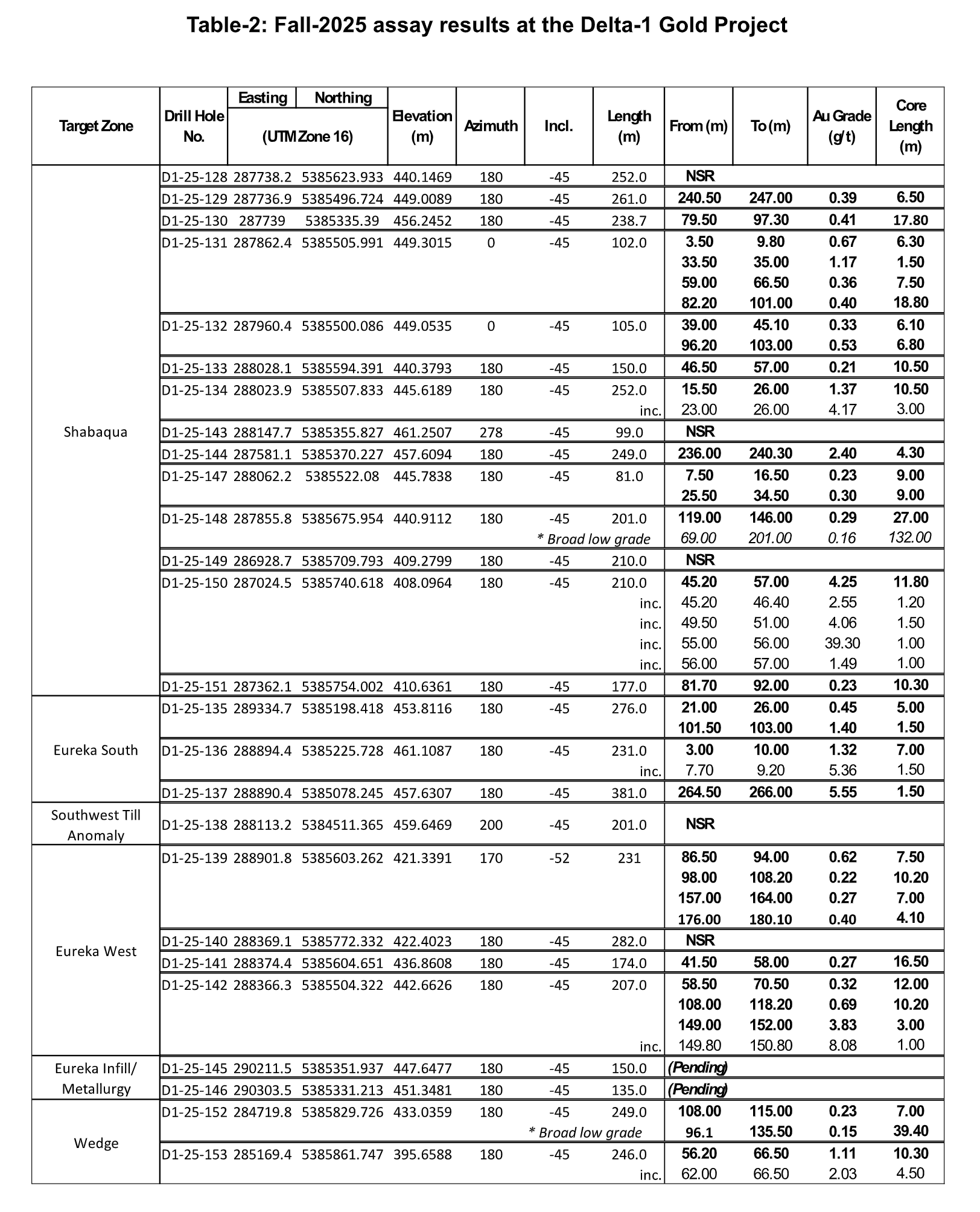
Delta’s initial phase of drilling at the Shabaqua Target demonstrates the potential for higher-grade gold mineralization beyond the currently defined Eureka footprint. Multiple higher-grade intervals were intersected in sulphide-rich chert and iron formation, including 4.25 g/t Au over 11.8 m in hole D1-25-150, 2.40 g/t Au over 4.30 m in D1-25-144 and 1.37 g/t Au over 10.50 m in D1-25-134. In addition, very broad intervals of low-grade, Eureka-style mineralization remain present in the sedimentary rocks, including hole D1-25-148, which returned 0.16 g/t Au over 132 metres.
I-Zone Target
The I-Zone sector is located approximately 18 kilometres southwest of the Eureka Gold Deposit and hosts several high-grade gold showings, including historical (non-NI 43-101 compliant) drill intercepts of 4.32 g/t Au over 41.0 metres, 4.53 g/t Au over 14.4 metres, and 4.36 g/t Au over 20.4 metres (Landore Resources, 1995–1997), as well as a 1,000-kilogram mini-bulk sample (Mengold Resources, 2008) that returned an average grade of 9.9 g/t Au.
We seek safe harbor. Neither TSX Venture Exchange nor its Regulation Services Provider accepts responsibility for the adequacy or accuracy of this release. The TSX Venture Exchange has not approved nor disapproved the information contained herein.
For Further Information:
Frank Candido, Chairman
Tel: +1-514-969-5530
fcandido@deltaresources.ca
Ron Kopas, CEO (Interim)
rkopas@deltaresources.ca
Cautionary Note Regarding Forward-Looking Information
Some statements contained in this news release are “forward-looking information” within the meaning of Canadian securities laws. Generally, forward-looking information can be identified by the use of forward-looking terminology such as “plans”, “expects”, “is expected”, “budget”, “scheduled”, “estimates”, “forecasts”, “intends”, “anticipates”, “believes” or variations of such words and phrases (including negative or grammatical variations) or statements that certain actions, events or results “may”, “could”, “would”, “might” or “will be taken”, “occur” or “be achieved” or the negative connotation thereof. Investors are cautioned that forward-looking information is inherently uncertain and involves risks, assumptions and uncertainties that could cause actual facts to differ materially. There can be no assurance that future developments affecting the Company will be those anticipated by management. The forward-looking information contained in this press release constitutes management’s current estimates, as of the date of this press release, with respect to the matters covered thereby. We expect that these estimates will change as new information is received. While we may elect to update these estimates at any time, we do not undertake to update any estimate at any particular time or in response to any event.